Short answer: VCs notice signal plus specificity. Show one number that matters to their thesis, in a message that could not have been sent to anyone else — and deliver it somewhere it can't be archived.
A partner at an active fund sees somewhere between 2,000 and 5,000 pitches a year and invests in maybe ten. Your problem is not that VCs are unreachable — it's that everything reaching them looks the same. Getting noticed is a targeting problem, not a volume problem.
1. Lead with a signal, not a story
Before any tactic, check that you have one thing worth noticing: revenue growth, unusual retention, a shipped product with real users, a team that is obviously suited to the problem, or a lead investor already committed. One sharp number beats three paragraphs of vision. If you don't have a signal yet, spend your energy earning one — every tactic below multiplies a signal and none of them replaces it.
2. Pick ten investors, not a hundred
Everything that follows only works against a researched shortlist. Filter by stage, sector, and recent activity — an investor who just led a deal in your space is either your best target or already conflicted, and you should know which before you reach out. If your targets are in the Bay Area, our map of 345 VC firms filters by stage and sector for free.
3. Send a cold email that respects their time
Cold email to VCs still works — it's just usually done badly. The version that works is five sentences: who you are, what you build, the one number that proves it's working, why this specific fund, and a clear ask. We wrote a full guide: how to cold email a VC and actually get a reply.
4. Build in public where they already scroll
Investors source from their feeds. A weekly post with real numbers, a teardown of a problem in your industry, or a launch thread with genuine traction does slow, compounding work. This is the only tactic on this list that gets investors to reach out to you — but it takes months, not days.
5. Borrow trust from their portfolio
The classic warm intro, engineered: find the portfolio founder whose company is most adjacent to yours, be genuinely useful to them, and let the intro come from someone whose judgment the investor already pays for. Slower than cold outreach, stronger per attempt.
6. Show up in the lobby (as a cake)
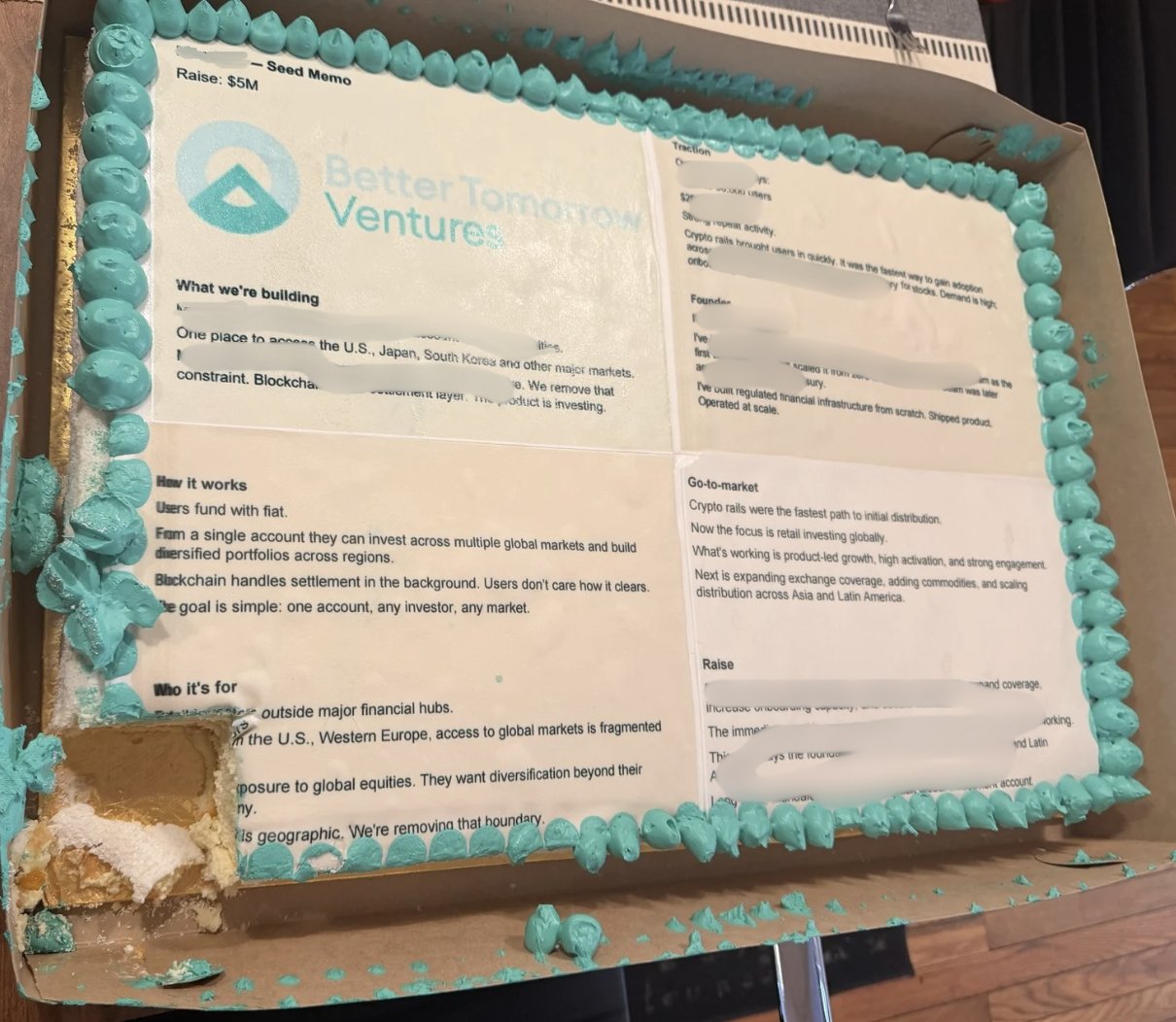
When the inbox is saturated, the desk is not. Founders have mailed decks with pizzas, sent handwritten notes, and — the version we run at Daymaker — baked the pitch onto a cake and hand-delivered it to the firm's lobby. A physical object gets handled by reception, carried into the office, photographed, and talked about; the QR code on it links to your deck. It does not scale, which is exactly why it works. See the reply rates and public receipts.
7. Time it to something real
Every tactic lands harder with a reason to exist now: a launch, a milestone crossed, a fund announcing a new thesis, a partner tweeting about your exact problem. "We just passed $20k MRR" is an event. "We exist" is not.
Put it in a sequence
- Week 1: shortlist ten investors, write ten individual emails, send five.
- Week 2: follow up once. For the one or two targets you most want, escalate to a physical send.
- After delivery: email while the office is still talking about it — "Did the cake arrive? Here's why we sent it."
The email earns a read. The cake earns a moment. The signal earns the meeting.
Want the tactic they'll post about?
Pick a VC on the map. We bake your pitch onto a cake and hand-deliver it to their lobby. $99.